
Last Updated: October 23, 2026
Quick Summary
A marine returning home for birth involves a service member racing to return from deployment before his child is born, navigating military emergency leave policies and the uncertainty of due dates. According to the USS Abraham Lincoln’s 2026 return, 122 Marines met their newborns for the first time after a 321-day deployment, representing families separated by operational demands and hoping for presence at birth.
- Emergency leave for childbirth without medical complications is not automatically granted by the military.
- Modern Marine deployments typically last 6-9 months, making it difficult to plan around pregnancy timelines.
- Some service members miss births entirely due to deployment extensions or early labor, creating lasting emotional impact.
- Military families should document leave requests in writing and establish backup support plans before deployment.
- When a marine does make it home, the first days involve reunion with a newborn he has never met.
Table of Contents
- A Marine’s Race Against Time: The Story of Coming Home for Birth
- The Impact of Deployment on Families During Pregnancy
- Military Deployment and Pregnancy: What Families Face
- When a Military Father Misses Birth of Child: The Reality
- Reuniting with Family After Deployment: The First Days Home
- Planning for the Unexpected: Practical Steps for Service Members
- Why Stories Like These Matter to Military Families
- Frequently Asked Questions
A Marine’s Race Against Time: The Story of Coming Home for Birth
When a Marine is deployed thousands of miles away, news of an impending birth can feel like an impossible choice: duty calls in one direction, family in another.
According to WKYT’s 2026 coverage of the USS Abraham Lincoln’s return, about 5,000 sailors and Marines returned home after a 321-day deployment, with 122 of them meeting their newborns for the first time. These numbers tell a larger story.
At Gregory S. Davis, we understand the weight of these stories. Our book, “10,000 Miles to the Delivery Room,” chronicles a Marine’s race to return home during Operation Desert Storm while his wife was expecting their first child, a story about sacrifice, hope, and families facing impossible odds.
This guide explores what it really means when a Marine tries to come home for a birth: the emotional reality families face, the practical constraints of military service, and what happens when a Marine returning home for birth becomes more than a hope, it becomes a plan.
The Impact of Deployment on Families During Pregnancy
Pregnancy is hard enough without a spouse deployed overseas. When a military father is thousands of miles away during his partner’s pregnancy, the emotional toll runs deep.
The birthing parent carries the physical burden alone: morning sickness, hospital visits, ultrasounds, all without their partner’s hand to hold. They sleep, worry, and prepare the nursery alone.
For the service member, the separation is equally painful. A Marine deployed during his wife’s pregnancy manages combat stress, operational demands, and the constant awareness that his child is being born without him. He misses the first kick, the baby shower, the preparation fathers usually share.
According to USNI News reporting on military deployments, the 22nd Marine Expeditionary Unit and USS Iwo Jima were heading home after nearly 10 months deployed. That’s nearly 300 days away. For many service members, a pregnancy that starts before deployment won’t end until well after they return.
Military families don’t get to plan around deployments the way civilians plan around work trips. A birth doesn’t pause for operational schedules, and a deployment doesn’t pause for a due date.
The hardest part of military pregnancy isn’t the physical separation, it’s the unpredictability. A due date is just a guess. A deployment schedule can change. Neither parent can control which one happens first.
Military Deployment and Pregnancy: What Families Face
A Marine returning home for birth requires understanding what deployment actually means. It’s not a business trip. It’s not a few weeks away.
Modern Marine deployments typically last 6-9 months, though some stretch longer. Service members are unreachable for days at a time, communicating through scheduled calls or email when internet access allows. Time zones make real-time contact nearly impossible, a wife in labor can’t call her husband and expect him to pick up.
The operational reality is stark: a Marine’s command doesn’t stop operations because a baby is coming. If a unit is in a combat zone or executing a critical mission, that Marine isn’t going anywhere.
Here’s what most people don’t understand about military emergency leave: childbirth is not considered a valid cause for emergency leave unless a complication occurs with the labor, delivery, or the health of the mother or child. A healthy birth, even a first child, doesn’t meet the threshold.
But due dates shift, babies come early, and pregnancies develop complications. A Marine who planned to be home before the due date can find himself still deployed when his wife goes into labor.
The emotional weight is immense. A service member watches his wife’s pregnancy progress from thousands of miles away, hears her anxiety, feels his own helplessness, and faces a question with no good answer: What if I can’t get home?
Emergency leave for childbirth without medical complications is not guaranteed. Service members who assume they’ll be home for a birth without confirming leave eligibility often face devastating disappointment when the request is denied.
When a Military Father Misses Birth of Child: The Reality
Sometimes a Marine returning home for birth doesn’t happen. The baby arrives before the service member can get back.
This scenario haunts military families. A wife goes into labor three weeks early. A deployment extension is announced. A flight home gets delayed.
The research shows this happens more often than people realize. When NBC DFW reported on Jacob Munoz’s deployment story, it captured exactly this situation: a Marine deployed while his wife was pregnant, barely making it home in time for his daughter’s birth.
For the service member, missing a birth creates a specific kind of grief. He’ll never get that moment back, the first cry, the first breath, the first moment of fatherhood.
For the mother, laboring without her partner is isolating. She has medical staff and family, but her spouse is absent. The birth is joyful and traumatic at once, she meets her baby while grieving her partner’s absence.
When a Marine misses the birth, the reunion is bittersweet. He comes home to a child he’s never met.
The long-term impact is real. Some service members report feeling disconnected from children born during deployment. The bonding that happens naturally in those first days and weeks doesn’t occur the same way.
Reuniting with Family After Deployment: The First Days Home
When a Marine returning home for birth actually makes it, those first days are overwhelming.
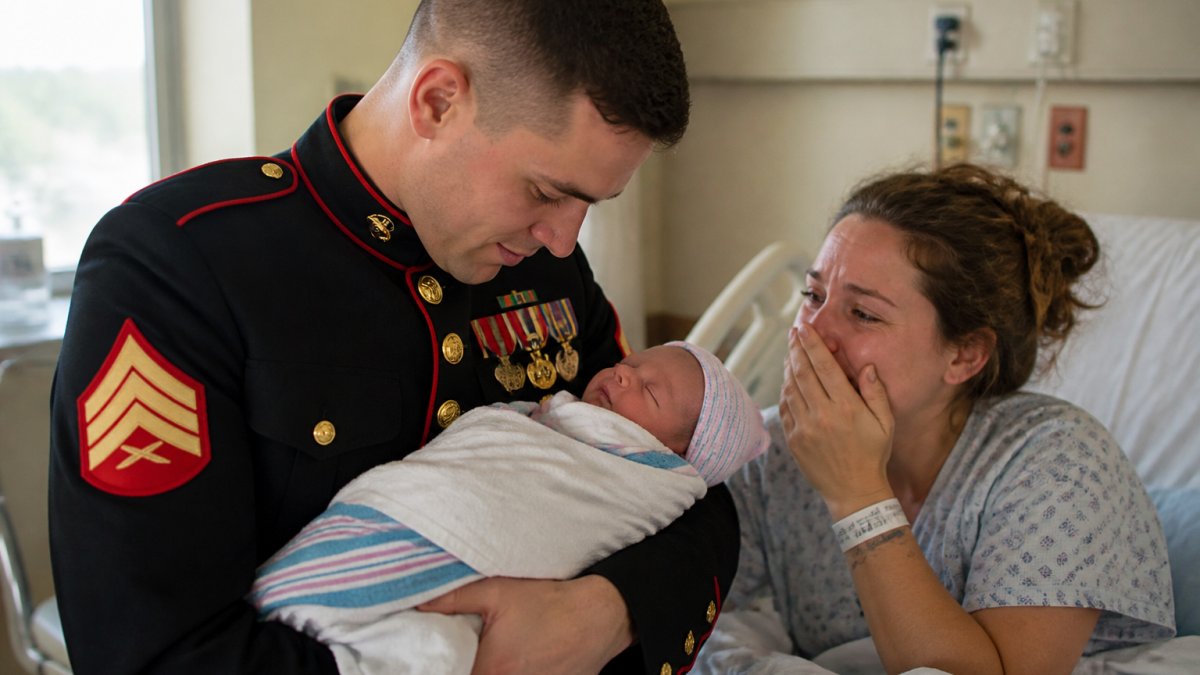
The reunion is emotional in ways civilians rarely experience. A service member hasn’t seen his spouse in months and missed her entire pregnancy.
The first meeting is surreal. The baby doesn’t know him, has no idea this man is his father. But the father knows.
For the mother, having her spouse home is a relief hard to describe. She’s managed pregnancy and labor alone; now she has backup, someone who can hold the baby while she sleeps and who understands the weight of what just happened.
The first days home are exhausting. A newborn doesn’t sleep, a Marine just back from deployment is jet-lagged and disoriented, and a mother recovering from childbirth is in pain and emotionally fragile. The romance of reunion collides with the brutal reality of newborn care.
But something profound happens: a Marine who missed months of his wife’s pregnancy gets to be present for the hardest part, the first weeks home with a newborn.
Planning for the Unexpected: Practical Steps for Service Members
If you’re a Marine facing deployment during your partner’s pregnancy, you need a plan. Not hope. A plan.
Start with your command. Talk to your officer and ask explicitly about emergency leave policies for childbirth. Get the answer in writing if possible, don’t assume, confirm.
Understand the timeline: when is your deployment, when is the due date, how many days between them? Build in a buffer.
Talk to your partner about contingencies:
- What happens if the baby comes early and you’re still deployed?
- Who will be in the delivery room if you’re not there?
- How will you stay informed if you’re overseas?
- What’s the plan for your first days home?
Consider remote participation. Some service members participate in labor via video call. It’s not the same as being there, but it’s something, discuss it with your partner and your command.
Prepare your partner for the possibility that you won’t make it. If she goes into labor and you can’t get home, she needs to know you tried, and she needs support lined up: family, friends, a doula, a therapist.
| Planning Element | Action | Timeline |
|---|---|---|
| Confirm leave policy | Talk to your command about emergency leave for childbirth | 6 months before deployment |
| Calculate buffer time | Count days between deployment end and due date | 5 months before deployment |
| Identify backup support | Arrange family or friends to be present if you can’t | 4 months before deployment |
| Discuss contingencies | Talk with your partner about what-if scenarios | 3 months before deployment |
| Explore remote options | Ask your command about video call participation | 2 months before deployment |
| Finalize backup plan | Confirm all arrangements are in place | 1 month before deployment |
The reality is this: you can’t guarantee you’ll be home for the birth. But you can reduce uncertainty. You can plan for what happens if you’re not. You can make sure your partner isn’t facing labor alone.
Document your leave request in writing. Email your chain of command with the due date, your request, and ask for written confirmation of approval or denial. Don’t rely on verbal promises. Written records protect you if circumstances change.
Why Stories Like These Matter to Military Families
A Marine returning home for birth is more than a heartwarming story. It’s a window into the real sacrifices military families make.
Civilians often focus on the happy ending: the Marine made it home, held his baby, everyone cried happy tears. But military families know the full weight, the months of separation, the fear it wouldn’t work out, and the families where it didn’t.
Stories like these matter because they validate the experience of military spouses and service members. They say: yes, this is hard. Yes, this is worth talking about. Yes, your sacrifice matters.
They also prepare people for reality.
At Gregory S. Davis, we believe these stories deserve to be told with honesty and depth. “10,000 Miles to the Delivery Room” isn’t a sanitized version of military life.
For military families navigating deployment during pregnancy, the emotional and practical challenges are real. A Marine returning home for birth is never guaranteed, but understanding the process, planning ahead, and building support networks can help families face uncertainty with strength. Gregory S.
Frequently Asked Questions
Can a deployed service member come home for the birth of a child?
A Marine returning home for birth depends on operational commitments, command approval, and deployment stage. Emergency leave may be granted for complications, but a standard birth is not automatically approved. Some service members do return, as seen when the USS Abraham Lincoln docked with 122 new fathers reuniting with their families after 321 days away. The process requires advance planning, communication with command, and realistic expectations about timing and availability.
What happens if a military father misses the birth of his child?
Missing a birth during deployment carries emotional weight that many military families experience. The service member meets the newborn for the first time at homecoming, which can be bittersweet. Families prepare by sharing photos, videos, and updates during deployment. Upon reunion, fathers often experience a mix of joy and grief over missed early days. Support from family, military family services, and shared stories, like those in memoirs chronicling a Marine’s journey through service, help families process and bond after separation.
How do military families prepare for childbirth when a parent is deployed?
Military families plan by identifying a support network (partner, parent, sibling, or friend) to be present during labor and delivery. Advance communication with the command about the due date is essential, though it does not guarantee leave approval. Some families arrange for video calls during labor if operational conditions allow. Creating a birth plan that accounts for solo parenting, postpartum recovery without the service member, and newborn care logistics reduces stress. Military family support programs and chaplain services offer counseling and resources.
What is the story behind ‘10,000 Miles to the Delivery Room’?
Gregory S. Davis’s memoir ‘10,000 Miles to the Delivery Room’ chronicles a U.S. Marine’s true journey through Operation Desert Storm while racing to return home for the birth of his first child. The book captures the profound tension between duty and family, showing how one service member navigated deployment, uncertainty, and the hope of being there for his child’s arrival. It serves as an authentic testament to the resilience and sacrifice military families face, offering readers, especially Gulf War veterans, military spouses, and military parents, an intimate perspective on the human cost of service.
