
Quick Summary
A military memoir birth story is usually a firsthand account of a service member missing or racing home for a child’s delivery, such as Gregory S. Davis’s 10,000 Miles to the Delivery Room. To find one, look for books whose authors name their branch, unit, and service dates, and check whether the book is labeled memoir or novel.
- Gregory S. Davis’s 10,000 Miles to the Delivery Room covers a Marine racing home for his first child’s birth.
- Most war writing centers on missions and dangers, so birth stories are rarely the focus.
- Strong memoirs move in order through pregnancy news, delivery, postpartum recovery, and reunion.
- Confirm the author’s branch, unit, and service dates against the book’s description and public biography.
- Check whether the book is labeled memoir, autobiographical novel, or fictionalized account before buying.
Table of Contents
- Why Few Military Memoirs Focus on Childbirth
- What a Military Memoir About a Child’s Birth Usually Covers
- Missing a Baby’s Birth During Deployment: A Military Dad’s Experience
- Military Deployment and Childbirth: How the Timeline Shapes the Story
- Military Family Stories Worth Reading Alongside a Birth Memoir
- How to Verify a Military Memoir’s Account Before You Buy
- Reading 10,000 Miles to the Delivery Room Next
- Frequently Asked Questions
Why Few Military Memoirs Focus on Childbirth
Military memoirs usually center on combat, strategy, and the drama of deployment. A birth, which happens quietly and far from the front, rarely fits that narrative. Gregory S. Davis’s 10,000 Miles to the Delivery Room is one example of a military memoir that covers the birth of a child during service.
The gap exists partly because most war writing is organized around missions and dangers, not domestic milestones. Research on military children from birth to five is also described as limited in some areas, which suggests the family side of deployment has received less systematic attention overall (Osofsky and Chartrand, Military Children from Birth to Five Years).
What a Military Memoir About a Child’s Birth Usually Covers
A memoir of this type typically moves between two worlds: the mission and the home front. The author describes the call to deploy, the distance, and the anxiety of missing a pregnancy milestone.
Common threads include:
- The news of pregnancy received while separated
- Efforts to get home before the due date
- Communication across distance and time zones
- The emotional weight of arriving late, or not at all
Missing a Baby’s Birth During Deployment: A Military Dad’s Experience
Missing a child’s birth is one of the most painful experiences a deployed parent can face. A Marine in a dusty field camp at dusk, holding a folded letter and looking toward the horizon, captures the emotional distance that such a memoir tries to convey.
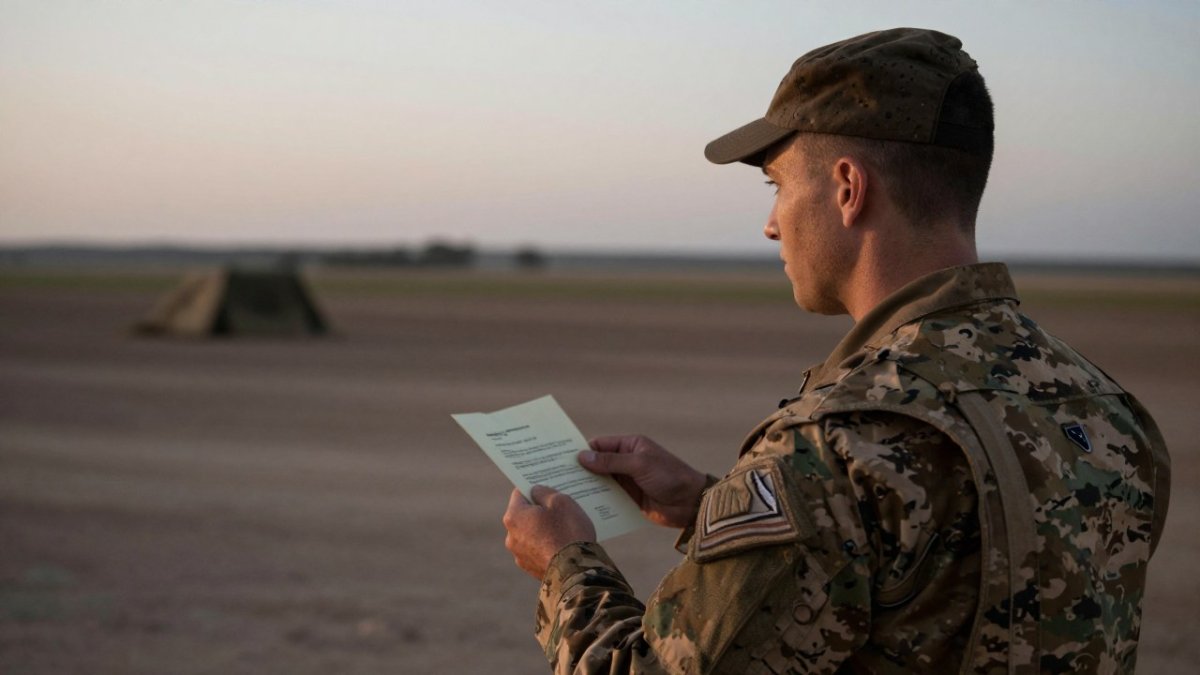
Davis’s account centers on a Marine racing to reach home before his first child arrives. Read a true story of a Marine returning home for a birth to see how deployment timing shapes such accounts.
Military Deployment and Childbirth: How the Timeline Shapes the Story
The timing of a deployment determines how a birth story unfolds, and the strongest memoirs make that timeline explicit.
Pregnancy and the news. A service member may learn of a pregnancy by phone, email, or a Red Cross message rather than in person. Memoirs that cover this phase tend to focus on the gap between receiving the news and being able to respond to it, the delay built into military communication is itself part of the story.
Labor and delivery. This is where the timeline becomes most concrete. A memoir may describe a spouse going into labor while the service member is in a training area, on a ship, or at an overseas assignment, and the author often reconstructs the hours by comparing time zones. The reader can track the birth against the service member’s duty schedule, which is why first-person accounts organized around dates usually feel more grounded than ones that reconstruct events loosely.
Postpartum recovery and the partner’s absence. A birth memoir does not end at delivery. The weeks after, recovery, sleeplessness, and the spouse managing alone, are often the emotional core, and they are the phase most combat-focused memoirs skip entirely.
The service member meeting the newborn. For deployed parents, this may happen days, weeks, or months after birth. The reunion scene is frequently the book’s climax, and it is where the memoir’s honesty about distance is tested most.
When you evaluate a memoir, check whether the author names the phase clearly and describes the circumstances around it. A first-person account that moves through pregnancy, delivery, postpartum recovery, and reunion in order will give you a far more concrete picture than one that jumps between combat scenes and a single birth date.
The article breaks a birth memoir’s story into phases, each with its own circumstances to check for.
| Phase | What the memoir covers | What to check |
|---|---|---|
| Pregnancy and the news | Learning of the pregnancy by phone, email, or Red Cross message | Gap between receiving news and responding |
| Labor and delivery | Spouse in labor while service member is away | Dates tracked against duty schedule and time zones |
| Postpartum recovery | Weeks of recovery and the spouse managing alone | Whether the author covers this phase at all |
| Service member meets newborn | Reunion days, weeks, or months after birth | Honesty about distance in the reunion scene |
Military Family Stories Worth Reading Alongside a Birth Memoir
Look for books with clear authorship and firsthand perspective. Family-centered memoirs often reveal more about daily life than broader histories do.
How to Verify a Military Memoir’s Account Before You Buy
The goal is to confirm two things: that the author actually served as described, and that the book is a firsthand account rather than a novel or an as-told-to reconstruction.
Start with the author’s service record. Confirm the branch, unit, and service dates against the book’s own description and, where available, the author’s public biography. A memoir that names a specific deployment, a specific duty station, and a specific due date is easier to check than one that stays vague about all three.
Then check the book’s label. Memoir, autobiographical novel, and fictionalized account are different categories, and some birth stories are marketed loosely. Look at the publisher’s category listing and the copyright page; a small press or self-published memoir is not automatically less reliable, but it usually means fewer editorial checks, so read sample pages closely.
A few checks help:
- Confirm the author’s branch, unit, and service dates.
- Check whether the book is labeled memoir, novel, or fictionalized account.
- Search library subject headings for military family memoirs.
- Read sample pages to judge how specific the timeline is.
- Look for reviews that mention the birth, not just the deployment.
Reading 10,000 Miles to the Delivery Room Next
Gregory S. Davis’s 10,000 Miles to the Delivery Room chronicles a U.S. Marine’s journey through the challenges of Operation Desert Storm while racing to return home for the birth of his first child. Read the book’s own description and contents before deciding. It offers a firsthand look at how a military family’s most important moment unfolds at a distance.
If this is the kind of story you are looking for, check the author’s website for current availability, formats, and pricing.
Buy The Book from Gregory S. Davis to read the full account of one Marine’s race home.
Frequently Asked Questions
What is 10,000 Miles to the Delivery Room about?
10,000 Miles to the Delivery Room is a first-person account by Gregory S. Davis, a U.S. Marine veteran. It follows a Marine during Operation Desert Storm as he races to return home for the birth of his first child. Readers interested in personal accounts of the Gulf War era may find its intimate perspective useful. Current pricing and formats are available on the author’s website.
What are some military memoirs about becoming a parent?
Memoirs about becoming a parent during military service are less common than war memoirs, which is why they are worth seeking out. Look for books where the author writes about pregnancy, prenatal appointments, or the birth from a distance. Check whether the author is a service member, a spouse, or a family member, since each perspective shows a different side of the experience. Reading several accounts gives a fuller picture of how families handle these milestones.
How do military families stay connected during deployment?
Military families commonly stay connected through scheduled phone or video calls, letters, recorded messages, and shared photos or updates when communication is available. Many families also keep routines, such as reading the same bedtime book aloud by video. Memoirs that describe these methods show how couples and children maintain bonds across long distances and time differences. The strategies vary by unit, location, and mission.
How can I tell whether a military memoir is an authentic account?
Check the author’s stated military service, look for publisher details and a clear author biography, and read any available reviews from veterans or families. Authentic memoirs usually include specific dates, locations, and unit details without claims that cannot be checked. Be cautious of books that rely on vague heroics or lack any verifiable background. Comparing the account with the author’s official website or publisher listing helps confirm the details.
