
Quick Summary
Yes, if you want an honest look at how deployment and fatherhood collide. Gregory S. Davis’s memoir follows a Marine racing home during Operation Desert Storm to see his first child born, and it captures the guilt, fear and missed milestones that come with that distance.
- The memoir is Gregory S. Davis’s 10,000 Miles to the Delivery Room, written from a Marine’s point of view.
- The father experiences a rotation of guilt, fear and relief, often within the same day.
- Research cited in the article links deployment to parent stress, child behavior problems and child maltreatment.
- Reintegration brings role renegotiation, children who may treat the returning father as a stranger, and a father’s own readjustment.
- Families are advised to aim for a new normal rather than expecting a quick return to how things were.
Table of Contents
- The True Story Behind Deployment and Fatherhood
- Becoming a Father While Deployed
- How Deployment Shapes Family Life Back Home
- A Father’s Emotional Experience Between Two Worlds
- Staying Connected With Family During Deployment
- Reintegration and What Military Fathers Face at Home
- Books About Military Deployment and Family to Read Next
- Reading 10,000 Miles to the Delivery Room Yourself
- Frequently Asked Questions
The True Story Behind Deployment and Fatherhood
Last Updated: November 4, 2026
Most people picture war as battles, strategy, and heroism. Fewer think about the quiet question that follows a Marine halfway around the world: will I make it home in time to hold my child? That tension sits at the center of Gregory S. Davis’s memoir, 10,000 Miles to the Delivery Room, a true story that tracks one Marine’s race home during Operation Desert Storm to see the birth of his first child. Readers curious about the full account can find the complete memoir on the author’s site. At Gregory S. Davis, we think the book’s real subject is the family waiting on the other side of the distance, and that makes it a useful read for anyone wondering whether a true story of deployment and fatherhood is worth their time.
The book is written from a Marine’s point of view, and it is candid about the disruption deployment causes. The story moves through the gap between the call to war and the moment of return, which is where the emotional weight of the narrative lives.
Schachman’s study on the lived experience of first-time fatherhood among combat-deployed military men, which reports that more than 90% of U.S. fathers attend the births of their children
Becoming a Father While Deployed
Becoming a father is hard to imagine from thousands of miles away. A child’s arrival is a milestone that arrives on its own schedule, and deployment does not always bend to it.
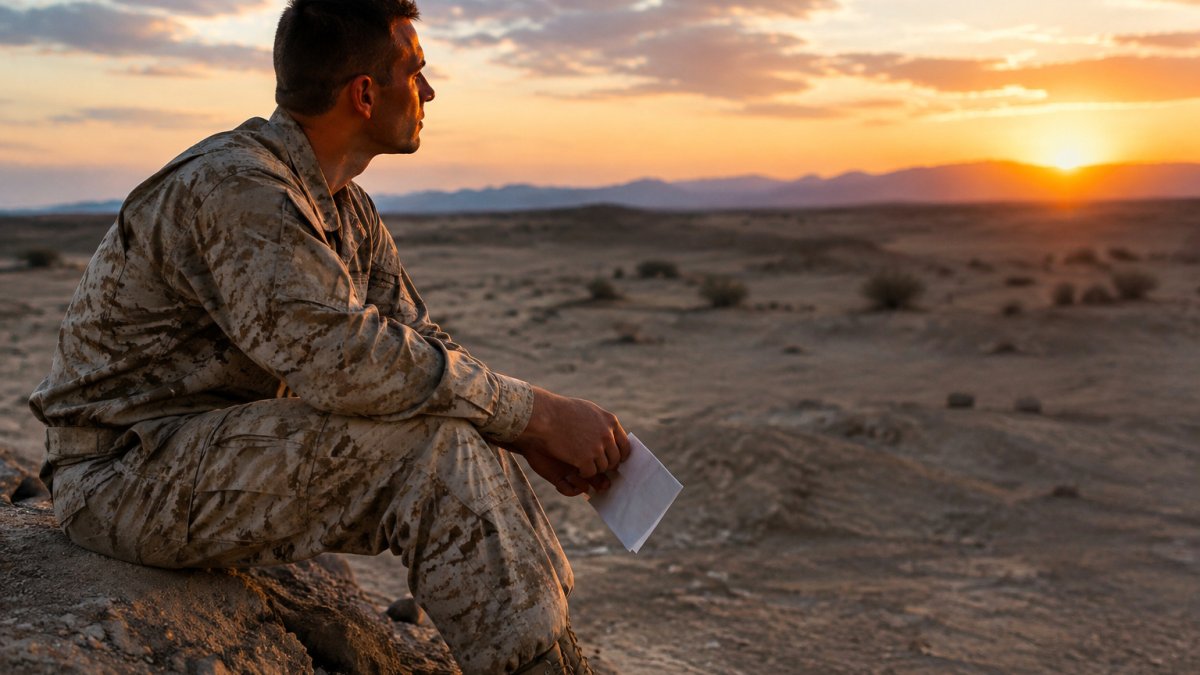
A 2010 study in the Journal of Advanced Nursing explored exactly this, looking at how military men experienced first-time fatherhood while deployed to combat regions the published study on the experience of first-time fatherhood in combat-deployed military men. The memoir gives that experience a specific face, one Marine’s frantic effort to close the gap before the birth. For a closely related true account, read Marine Returning Home for Birth: A True Story.
How Deployment Shapes Family Life Back Home
The effects of deployment reach well beyond the deployed parent. Research published in Nursing Outlook in 2015 reported that deployment was associated with increased parent stress, child behavior problems, health-care use, and child maltreatment the 2015 Nursing Outlook study on deployment and military families with young children. Those findings matter for readers who want to understand what a spouse or child carries during a separation, not only what the deployed father carries. A deeper look at how deployment affects families at home is available in our guide.
Family life back home is shaped by the same absence that drives the memoir’s tension. The people waiting are not passive. They manage households, schedules, and fears while the father is away.
A Father’s Emotional Experience Between Two Worlds
The father in this story is caught between the mission and the family he is racing toward, and the memoir is unusually direct about what that split feels like from the inside. The emotional experience is not a single feeling but a rotation of them, often within the same day.
Guilt is the most persistent. It shows up when a father misses a prenatal appointment, a first ultrasound, or the moment a spouse goes into labor, and it does not fade simply because the absence was ordered. Fear is the second: fear of not making it home, fear of arriving too late, fear that the child will bond with someone else first. Then there is the strange guilt of feeling relieved to be away from the intensity of home life, followed immediately by shame for feeling relieved. The memoir captures that rotation without tidying it up.
A service member learns to wall off the family worry to function on mission, but the wall leaks at night, during mail call, or when a care package arrives with a sonogram taped inside. The result is not constant sadness but unpredictable surges of it, which can look like irritability or withdrawal to the people around him.
Missed milestones carry a specific weight. A first step, a first word, a birthday, these are not interchangeable events, and a father knows exactly which ones he lost. The memoir treats the delivery room as the milestone that matters most, but the same logic applies to every first that happens while he is gone. That is why the book’s title is not really about a distance in miles; it is about the gap between the life he is living and the life he is missing.
Pagano et al., The Long-Term Effects of Parent Military Deployment on Adult Children
The emotional impact of separation can outlast the deployment itself. For a father reading the memoir, that is both a warning and a reason to take the emotional work seriously while it is happening, not only after he returns.
Watch out: treating the father’s guilt as something to “get over” rather than something to name and manage can turn a temporary strain into a long-term pattern of emotional distance.
Staying Connected With Family During Deployment
Keeping a bond alive across an ocean takes deliberate effort. Communication during deployment is often irregular, which makes each contact carry extra weight.
What the memoir shows is the value of staying present in whatever small ways are possible: letters, calls, and the steady intention to be part of a child’s first months.
Reintegration and What Military Fathers Face at Home
Returning home is not the end of the story, and the memoir is honest about that. The homecoming itself can be a high point, but the weeks and months after it are where the real adjustment happens. Families often have to rebuild routines and expectations after a long separation, and the research on deployment points to continuing strain on children and parents alike.
The first challenge is role renegotiation. While the father was away, the spouse became the sole decision-maker, the disciplinarian, the scheduler, and the emotional anchor. When the father returns, both people have to relearn how to share those roles, and the process is rarely smooth. A common pattern is that the returning father tries to resume authority immediately while the spouse, who has been running the household alone, is reluctant to hand it back. Children notice the tension even when no one names it.
The second challenge is the child’s reaction. A young child may treat the returning father as a stranger, clinging to the spouse and refusing comfort. A school-age child may swing between excitement and resentment, testing limits that did not exist during the deployment. A teenager may have developed independence that now feels like rejection. None of these responses is a sign that the deployment failed; they are normal adjustments to a changed family system.
The third challenge is the father’s own readjustment. The structure of deployment, clear tasks, clear hierarchy, clear purpose, can make ordinary family life feel chaotic by comparison. Some fathers describe missing the intensity of deployment, which is difficult to admit and easy to misread as a wish to be away again. Repeated deployments compound this: each return is a new negotiation, and the family may never settle into a stable routine before the next departure.
Injury adds another layer. When a father returns with a physical or psychological injury, the family’s adjustment includes caregiving, medical appointments, and a changed sense of what the father can do. The memoir does not offer a tidy resolution, and that is an honest reflection of how many military families describe reintegration: not a single homecoming but a long series of small homecomings, each one requiring patience from everyone involved.
Watch out: expecting the family to “get back to normal” quickly can set everyone up for disappointment; the more realistic goal is a new normal that everyone helps build.
The article describes several distinct challenges families face once a deployed father returns home.
| Challenge | Who it affects | What the article describes |
|---|---|---|
| Role renegotiation | Father and spouse | Spouse became sole decision-maker; roles must be shared again |
| Child’s reaction | Young child | May treat returning father as a stranger and cling to spouse |
| Father’s readjustment | Returning father | Ordinary family life can feel chaotic after deployment structure |
| Injury | Whole family | Caregiving, medical appointments and changed abilities |
| Repeated deployments | Whole family | Each return is a new negotiation with no settled routine |
Books About Military Deployment and Family to Read Next
If this memoir speaks to you, look for other accounts that explore the family side of military service rather than only the battlefield. Personal accounts and academic research each offer a different angle on the same experience, and reading both can deepen your understanding. For why firsthand writing often reveals more than official records, see why personal journals preserve the most honest history of war.
Reading 10,000 Miles to the Delivery Room Yourself
10,000 Miles to the Delivery Room: A US Marine’s Private Journal from the Call to War and His Race to Get Home is written in a voice that is personal and reflective rather than heavy with combat detail. Readers who want a true story about the bond between a father and his unborn child, and about the strain distance places on that bond, will find the book rewarding. Gregory S. Davis, a U.S. Marine veteran, tells the story from the inside, and that first-person perspective is what gives it its weight. If you are considering it, the book is available through the author’s site, where you can find current pricing and ordering details.
Frequently Asked Questions
Can a husband come home from deployment for the birth of his child?
Sometimes, but it depends on the operation, the unit’s mission and the chain of command. Emergency leave is typically granted for serious family situations, while a routine birth may not qualify. Service members should contact their unit’s family readiness office or chaplain early in the pregnancy to understand options. Gregory S. Davis’s account of racing home for his first child during Operation Desert Storm shows how much these decisions can hinge on timing and command approval, not just on the wishes of the father.
How does military deployment impact family relationships?
Families often adjust roles, routines and communication during separation, and reintegration can bring its own strain. Military families can also look for support resources through official military channels.
What challenges do military fathers face when returning home?
Returning fathers often find that children have grown, routines have changed and family members have adjusted to life without them. Many also carry combat-related experiences that affect their emotional readiness to rejoin family life. Reintegration works better when families set realistic expectations, talk openly about changes and seek support early. Veterans and spouses describe this adjustment period as one of the least discussed parts of deployment, which is why personal accounts can be so useful for understanding it.
Is 10,000 Miles to the Delivery Room worth reading?
It suits readers who want an intimate, first-person memoir rather than a textbook. Gregory S. Davis, a U.S. Marine veteran, tells the story of racing home from Operation Desert Storm for the birth of his first child. Readers who served, who are military spouses or who are interested in personal history will likely find it relatable. For pricing, format and availability, check Gregory S. Davis’s website directly, as prices are not listed here.
